AI in the hair salon: post, plan and advise, without the pitfalls
AI is already part of salon life: Instagram posts are drafted by text assistants, apps show clients a new style on their own photo, the booking bot answers at night. Legally, almost everything hangs on two questions: what happens to client photos, and when must an AI image be disclosed as one? Both can be answered cleanly with a few clear rules.
By Patrick de Kathen, Founder of KlarComply · Reviewed on
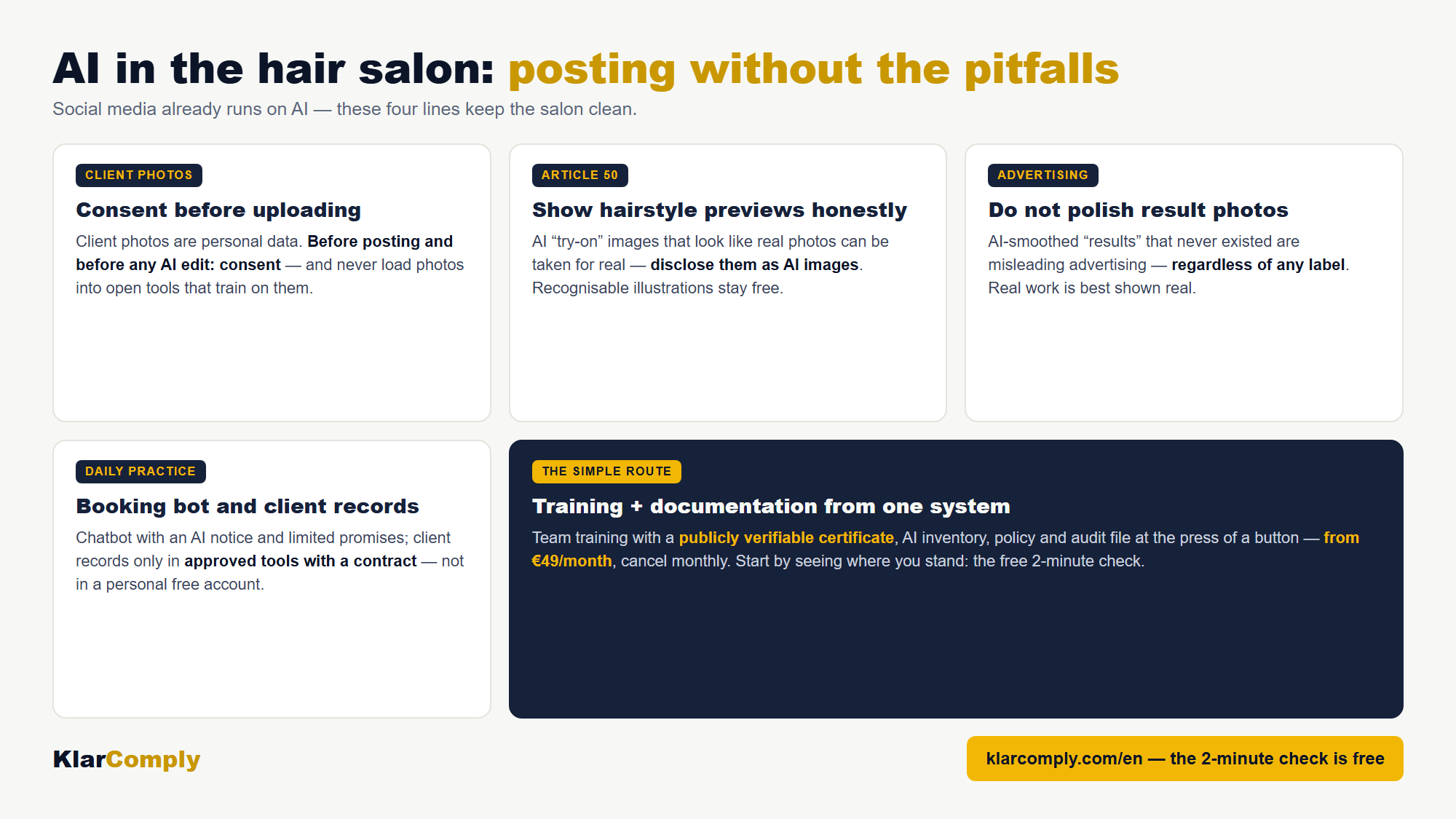
The strongest lever: client photos are personal data
The salon's most valuable material, photos of clients, is also its most legally sensitive. A face is personal data; the moment a photo is loaded into an AI tool, processing takes place, and with free public tools the input may also be used to train the model.
Two simple rules cover almost everything in daily practice:
| Situation | Rule |
|---|---|
| Posting a client photo, or editing it with AI | Obtain consent first, ideally in writing, with one sentence on the client card. Consent to posting does not automatically cover AI editing; ask for both. |
| Loading a photo into an AI tool | Only into tools that contractually promise not to reuse your inputs (business tier with a data processing agreement), never into personal free accounts. |
AI hairstyle previews: be honest about what is not real
“Try-on” tools that simulate a new colour or cut on a client's photo are a strong consultation aid, at the chair, in conversation, entirely unproblematic. It changes the moment such images are published: a photorealistic AI image that a viewer could take for a genuine result photo falls under the disclosure duty of Article 50 of the EU AI Act, in force since 2 August 2026. The labelling is free of form, a visible note such as “AI-generated preview” right by the image is enough. There is no official symbol.
The sharper line is advertising law
More important than any label: AI-smoothed “result photos” showing a quality that never existed are misleading advertising: and the most honest AI note changes nothing about that. Real work is most credibly shown real. The labelling question only arises once the image itself is clean.
Booking bot and WhatsApp channel
A chatbot that books appointments and answers price questions saves real time. Two things belong with it: first, the notice that one is writing with an AI, formally the system provider's duty, but it belongs visibly in your channel, because with a bot under your name every answer reflects on the salon. Second, clear limits: a Canadian tribunal ruled in 2024 that a company is liable for the false answer of its own chatbot. Prices, promotions and exceptions therefore belong in a maintained knowledge base, and everything else with a human.
What the salon should document
Even a three-person salon benefits from three short documents: a list of the AI tools in use (the AI inventory), half a page of rules (who may post what, which tools are approved, how AI images are labelled) and a training record per person. It sounds like bureaucracy, but it is the difference between “we sort of handle it” and an answer when a client, a trade body or a landlord asks.
Where to start
The free 2-minute check shows where your salon stands. Training with a publicly verifiable certificate, a maintained inventory and the audit file come with the subscription from €49/month, 12-month minimum term.
Frequently asked questions
Do I have to label every AI-edited image on Instagram?
No. The duty covers images a viewer could take for genuine photos, such as a photorealistic AI hairstyle preview. Recognisable illustrations and normal photo corrections are not covered. Independently of that: results that never existed are misleading advertising, with or without a label.
May I upload client photos to a hairstyle app?
Only with the consent of the client and only into tools that contractually do not reuse your inputs (business tier with a data processing agreement). Personal free accounts are off limits for client photos.
Where does your company stand?
The free quick check walks through ten points, AI inventory, training status, transparency duties, responsibilities. Two minutes, no sign-up, an honest result and your concrete gaps.
Start the quick check, freeArticle 50 AI Act, transparency obligations (labelling)
Article 4 GDPR, definitions (personal data)