Labelling AI content: the duty that is actually enforced
The transparency obligations in Article 50 have applied since 2 August 2026, complete with a penalty range. The Digital Omnibus expressly did not move that date. For a company that only uses AI, this is the first duty that becomes visible from the outside. It takes about half an hour to deal with — and in most organisations it still has not been done.
By Patrick de Kathen, Founder of KlarComply · Reviewed on
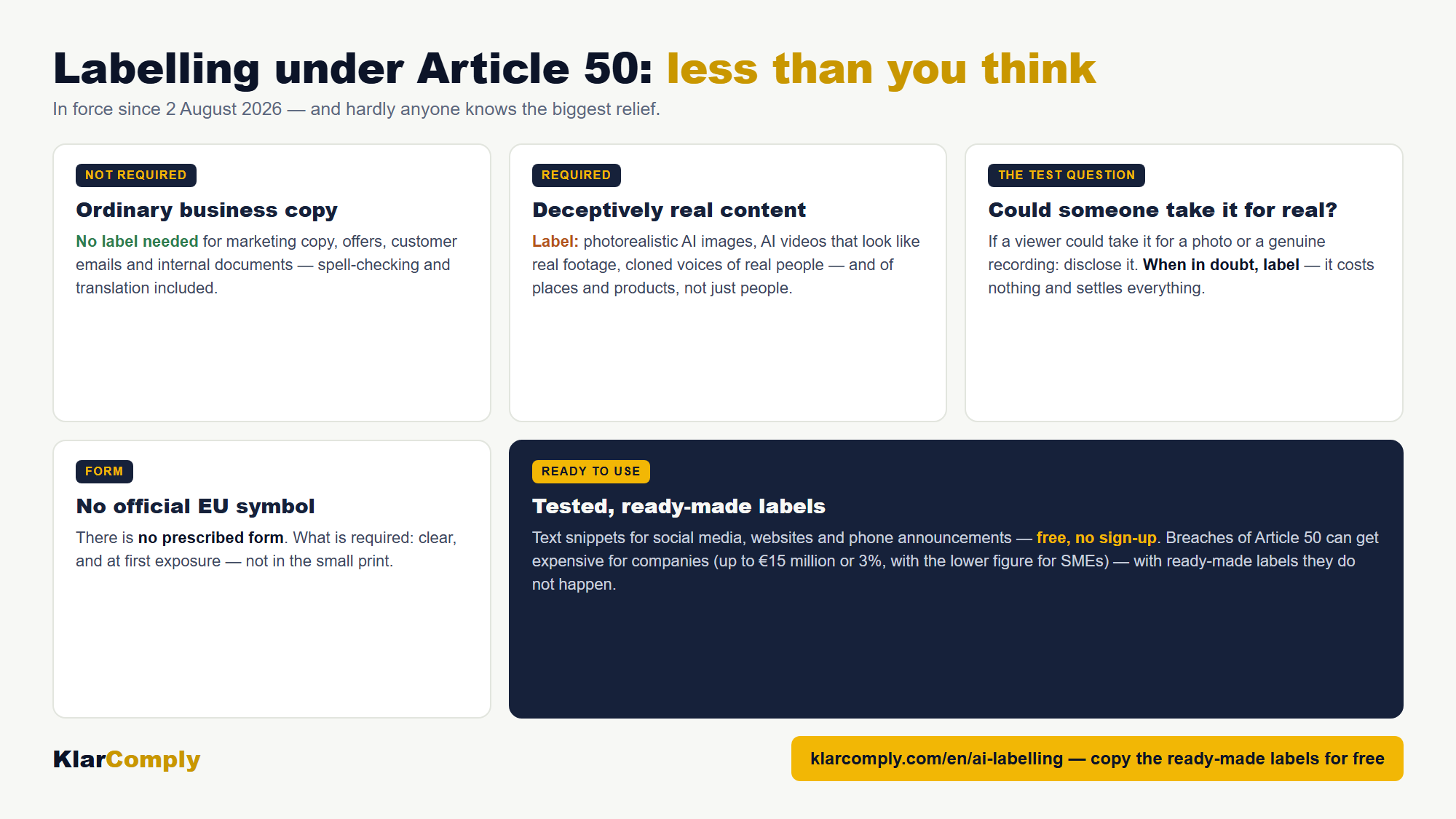
The duty applies — since 2 August 2026
What the Digital Omnibus postponed was the high-risk regime, to December 2027 for standalone systems and August 2028 for AI embedded in regulated products. The date of 2 August 2026 was left untouched. Since that day the transparency obligations in Article 50 have applied, and the national market surveillance authorities designated by each member state have been operational.
Every other duty stays indoors. Your inventory, your policy and your training records are seen only by someone who asks for them. A missing notice on a chat window, or under an AI-generated photograph, is seen by everyone who opens your website. That is why this is the duty that gets noticed first — and why it is still open in so many organisations even though it has been in force for months.
Article 50 is directly subject to fines
Unlike the AI literacy duty in Article 4, Article 50 appears expressly in the penalty catalogue: Article 99(4)(g) names it. The range is up to 15 million euros or 3 per cent of total worldwide annual turnover, whichever is higher. For small and medium-sized enterprises, Article 99(6) provides that the lower of the two amounts applies.
That is the statutory ceiling, not a forecast of practice. Realistically an authority opens with a request for information and an order to remedy. The point is a different one: this is the cheapest duty in the entire regulation to satisfy. It costs one line of text per channel.
If you are established outside the EU
Article 2 extends the regulation to providers and deployers in a third country where the output produced by the AI system is used in the Union. Article 50 is where that bites first and most visibly, because the output in question is published.
A US company running an AI chat assistant on a site that serves EU customers, a UK agency publishing photorealistic AI imagery to an EU audience, a Swiss firm using a cloned voice in a phone line that EU callers reach — in each case the content is output used in the Union, and the disclosure duty attaches to whoever puts it out. Being headquartered outside the EU is not a defence, and no separate EU registration is needed for the duty to apply.
Which paragraph binds whom
Article 50 splits its duties between two roles — providers and deployers. Those get conflated constantly, almost always to the disadvantage of the company that merely uses the tool. The allocation:
| Provision | What it covers | Who it binds |
|---|---|---|
| Art. 50(1) | People are told they are interacting with an AI system | Providers of the system |
| Art. 50(2) | Machine-readable marking of generated content | Providers only |
| Art. 50(4) first sentence | Disclosure of deepfakes | Deployers — that is you |
| Art. 50(4) second sentence | Disclosure for AI text on matters of public interest | Deployers — with a broad exemption |
For an ordinary company that uses AI rather than builds it, paragraph 4, first sentence is the one that matters. The first two paragraphs address the makers of the tools.
The duty that really concerns you: deepfakes
A deployer of an AI system that generates or manipulates image, audio or video content constituting a deepfake must disclose that the content has been artificially generated or manipulated. The duty attaches to publication, not to the tool. It falls on whoever puts the content out into the world.
What "deepfake" means in the regulation
Article 3(60) defines it as AI-generated or manipulated image, audio or video content that resembles existing persons, objects, places, entities or events and would falsely appear to a person to be authentic or truthful.
That is wider than the everyday sense of the word. It does not require the face of a specific real individual. It captures photorealistic scenes and invented but convincing people — an AI-generated team photo, a synthetically produced advertisement, a cloned voice on a phone greeting. Note the words "objects, places, entities or events": a generated photograph of a product that does not exist in that form, or of premises you do not have, is squarely within the definition.
A working rule — with an honest caveat
Classification in borderline cases is contested and there is no settled interpretation yet. Anyone who tells you the line is clear is guessing with more confidence than the material supports. As a working rule: could a viewer take this for a real recording? If yes, label it. Where it is evident that the content is an illustration, a drawing, an icon or an abstract graphic, the duty does not arise.
In case of doubt, labelling is the cheaper path. It costs one line. Explaining afterwards why you left it off costs considerably more.
Art, satire and fiction
Where the content forms part of an evidently artistic, creative, satirical or fictional work or programme, the duty is limited to disclosing the existence of such generated or manipulated content in an appropriate manner that does not hamper the display or enjoyment of the work. A note in the credits or in a caption is then enough. The regulation does not require a work to be spoiled by its own disclosure.
AI-written text: the exemption that rarely gets mentioned
The second sentence of paragraph 4 is routinely reported as though every text written with AI has to be labelled. That is not what it says. The duty has two limitations, and both are substantial.
First, it covers only text published for the purpose of informing the public on matters of public interest. A piece of marketing copy, a product description or a quotation does not inform the public on a matter of public interest — it promotes an offering.
Second, the duty does not apply where the AI-generated content has undergone a process of human review or editorial control and where a natural or legal person holds editorial responsibility for the publication.
| More likely caught by the second sentence | More likely not caught |
|---|---|
| A press release about a product recall, a sustainability report, a statement on an incident, contributions on political, environmental or health topics | Product descriptions in a shop, quotations, ordinary advertising copy, newsletters, internal circulars, appointment confirmations |
What this means day to day
Ordinary marketing copy, product descriptions, proposals and internal documents are not subject to a labelling duty. And even for genuinely public-interest publishing, the duty falls away as soon as a person has reviewed the text and holds editorial responsibility for it.
One sentence in your internal policy covers this: "All externally published text is reviewed and approved before publication by [role]. That person holds editorial responsibility for the publication."
With that, the text limb of Article 50 is settled for most companies. Anyone telling you otherwise has not read the second sentence of paragraph 4 to the end.
Chatbots: paragraph 1 binds the provider — with one exception
Under paragraph 1, an AI system intended to interact directly with natural persons must be designed and developed so that the persons concerned are informed that they are interacting with an AI system. The addressee is the provider, not the deployer. The duty does not apply where this is obvious from the point of view of a reasonably well-informed, observant and circumspect person, taking into account the circumstances and the context of use.
Why this still matters for smaller companies
If you put a bought-in chatbot on your website under your own name or trade mark, Article 25 can make you the provider — and the paragraph 1 duty then lands on you directly. That is precisely the normal case for a branded website assistant. The same applies if you substantially modify the system or change its intended purpose.
The implementation is identical either way: a clear notice in the chat window, visible before the first message is typed. A line in the terms of use or the privacy notice does not satisfy it.
Machine-readable marking: not your problem
Paragraph 2 requires that the outputs of generative systems be marked in a machine-readable format and detectable as artificially generated or manipulated — watermarks, metadata, cryptographic provenance. This duty falls on providers only, meaning the makers of the tools. An ordinary deploying company is not addressed here.
We say that plainly because a great deal of anxiety is sold at this exact point. You do not need to embed a watermark in your images. The only sensible step is to note in your AI inventory whether a tool you use applies such a marking, because a customer may ask. For systems already placed on the market before 2 August 2026, a transitional period runs to 2 December 2026.
What to label, and what not to
The right-hand column is the more important one in practice. It stops you ending up with a disclosure on every email, at which point the labelling means nothing at all.
| Label | Do not label |
|---|---|
| Photorealistic AI images of people, spaces or products that could be taken for a photograph | Evident illustrations, cartoons, icons, abstract graphics |
| AI-generated or cloned voices, for example in phone greetings or advertisements | Ordinary marketing copy, product descriptions, quotations, newsletters |
| Synthetically generated or altered video that looks authentic | Spelling, grammar and phrasing help applied to text you wrote yourself |
| Chatbots and phone assistants, unless the AI is obvious from the context anyway | Internal documents, meeting notes and analyses with no external effect |
| AI text on matters of public interest published without human review | The same text where a person reviewed it and holds editorial responsibility |
What a label has to look like
The regulation prescribes no particular form and no official symbol. There is no EU AI seal. Anyone selling you one is selling an invention, and it is worth saying so before you buy a licence for a badge that does not exist.
What is required is that the disclosure be clear and distinguishable, provided at the latest at the time of the first interaction or exposure, and — for deployers under paragraph 4 — accessible, which in practice means it should also work for people using a screen reader.
- Works: "Created with AI." as a caption directly beneath the image
- Works: "You are chatting with an AI assistant. To speak to a person, call …" — visible when the chat opens
- Works: "This message uses a synthetic voice." at the start of the recording
- Does not work: a note in the legal notice, the terms and conditions or the privacy policy
- Does not work: a disclosure that appears only after sending, or only in the end credits of a video that is not a creative work
- Does not work: grey four-point type at the bottom of the page. "Clear and distinguishable" is a legal test, not a design preference
Ready-made labels to download
Because no form is prescribed, designing one usually takes longer than deciding to. We therefore produced a consistent set of labels and make it available at no charge, with no sign-up.
The KlarComply AI labels — free
- Three languages: English, German and Dutch
- Light and dark versions for different backgrounds
- With and without the KlarComply addition
On a subscription the labels can also be generated with your own logo, so the disclosure matches the rest of your presentation instead of looking bolted on.
A label is not a certificate of conformity
This needs saying plainly. A label documents that AI was involved in one specific piece of content. It does not certify that a company complies with the AI Act as a whole, and it replaces neither an inventory, nor a policy, nor training records.
It is an implementation aid for a single obligation — useful there, and meaningless beyond it. If a supplier presents a badge as evidence of overall compliance, that is a reason to look harder at the rest of their claims.
A checklist for your external channels
Go through it once, in full, and record the result with a date. For most companies the whole exercise takes about half an hour:
- Is there a chatbot on the website or an AI assistant on the phone line? → add the notice, visible before the first message
- Are photorealistic AI images in use on the website, in brochures or on social channels? → label them at the point of publication, not in a central disclaimer
- Is a synthetic or cloned voice used anywhere? → disclose at the start
- Does AI-written text on matters of public interest go out unreviewed? → make human approval binding and name the person who holds editorial responsibility
- Is the labelling rule written into your internal AI policy? → if not, add it, so it survives the person who currently remembers it
- Does the AI inventory record which tools generate image, audio or video? → add the column; it saves the next search
- If you work with an agency: is it contractually clear who applies the label? → the duty stays with you regardless
If you would rather not work out where you stand from scratch, the free quick check covers this alongside nine other points and takes about two minutes.
Frequently asked questions
Since when does the labelling duty for AI content apply?
Since 2 August 2026. The Digital Omnibus expressly did not move this date, unlike the high-risk obligations, which shifted to December 2027 and August 2028. For the machine-readable marking of systems already on the market beforehand, a transitional period runs to 2 December 2026.
Does Article 50 apply to companies outside the EU?
Yes, where the output is used in the Union. Article 2 extends the regulation to deployers in third countries whose AI output is used in the EU. A UK or US company publishing AI-generated content to an EU audience is within scope for that content.
Do we have to label every AI-written text?
No. The duty in Article 50(4), second sentence, covers only text published for the purpose of informing the public on matters of public interest. Ordinary marketing copy, product descriptions and quotations fall outside it. And even for public-interest publishing, the duty falls away where the text has undergone human review or editorial control and a person holds editorial responsibility.
Is there a prescribed symbol or EU seal for AI content?
No. The regulation prescribes neither a particular form nor an official mark. All that is required is that the disclosure be clear, distinguishable and provided at the latest at the time of first interaction or exposure. No official EU AI seal exists.
Who is liable for the label — our agency or us?
The duty under Article 50(4) falls on the deployer, meaning the company that uses and publishes the content. An agency can carry out the work; the responsibility stays with you. Put it in the contract and record who applies the label.
Do we have to embed watermarks in our AI images?
No. The machine-readable marking under Article 50(2) binds providers of AI systems only, not deploying companies. What remains for you is the visible disclosure under paragraph 4 where the content could pass as authentic.
Does an AI image without a real person already count as a deepfake?
Possibly. Article 3(60) covers content resembling existing persons, objects, places, entities or events that would falsely appear authentic. Photorealistic scenes and invented but convincing people can fall within it. Classification in individual cases is contested; the working question is whether a viewer could take it for a photograph.
Is a note in our terms and conditions enough for the chatbot?
No. The notice has to be clear and recognisable at the latest at the first interaction — that means in the chat window itself, not in a linked document.
What does a breach of Article 50 cost?
Article 99(4)(g) names Article 50 expressly. The range is up to 15 million euros or 3 per cent of total worldwide annual turnover; for small and medium-sized enterprises, paragraph 6 provides that the lower amount applies.
Where does your company stand?
The free quick check walks through ten points — AI inventory, training status, transparency duties, responsibilities. Two minutes, no sign-up, an honest result and your concrete gaps.
Start the quick check — freeArticle 50 EU AI Act — transparency obligations, full text
Article 3 EU AI Act — definitions (No. 60: deepfake)
Article 25 EU AI Act — when a deployer becomes a provider
Article 99 EU AI Act — penalties (paragraph 4(g) names Article 50)
Article 2 EU AI Act — scope, including third-country deployers
Regulation (EU) 2024/1689 — official consolidated text, EUR-Lex
European Commission — regulatory framework for AI