AI in the advertising agency: settle the roles before the client asks
Agencies produce AI content on commission, and the new duties of the EU AI Act sit exactly at that interface. The key question is rarely WHETHER something must be labelled, but WHO must do it: the disclosure duty of Article 50 lies with the deployer, for published campaigns usually your client. Professionally run agencies deliver the labelling anyway.
By Patrick de Kathen, Founder of KlarComply · Reviewed on
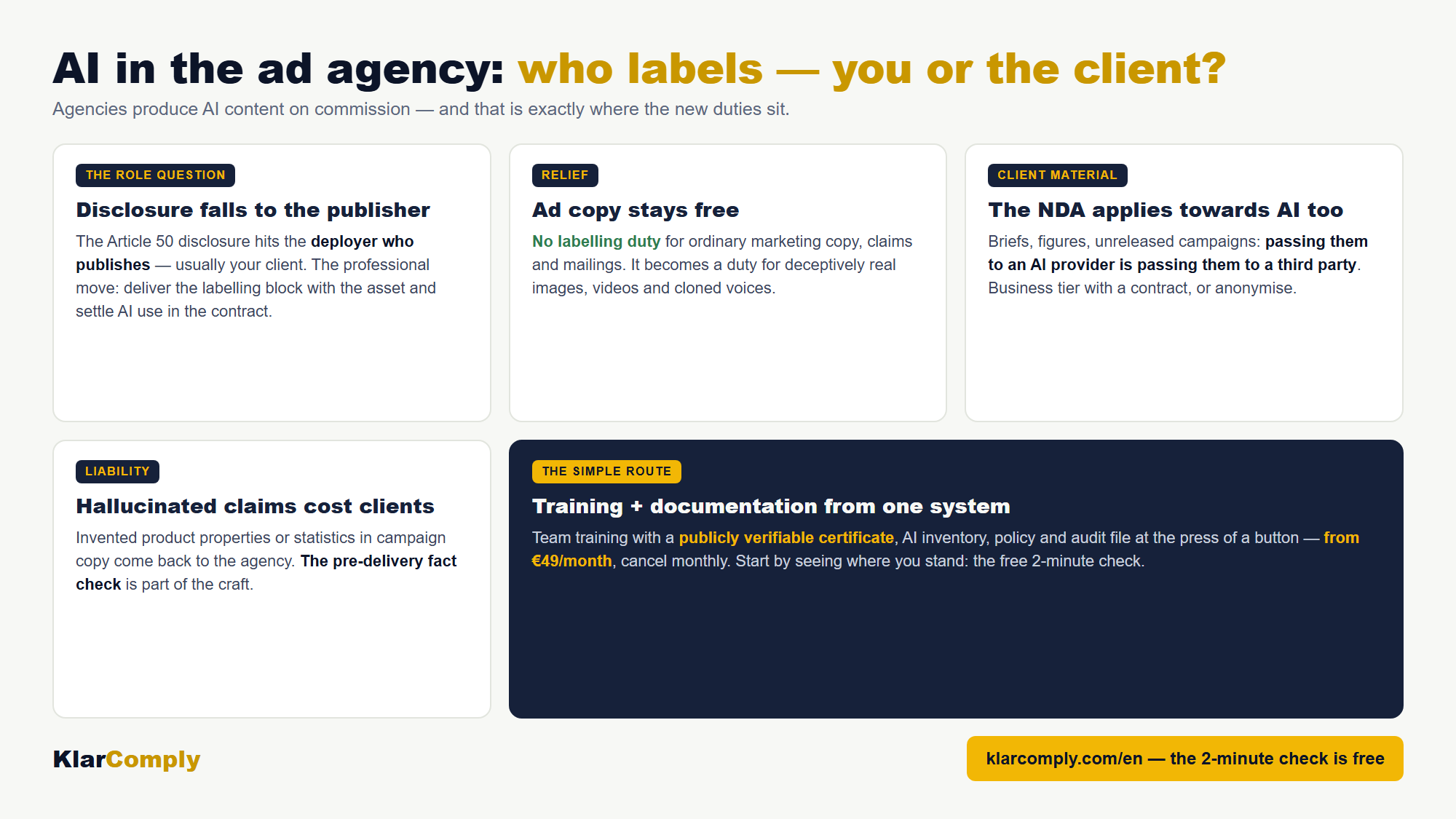
The role question: disclosure falls to the deployer, usually your client
Article 50(4) of the AI Act obliges the deployer of the AI system to disclose deceptively real content. Where the client publishes the campaign on its own channels under its own responsibility, much speaks for the disclosure sitting with the client, though the division of roles in commissioned production is not yet conclusively settled. What is certain: the notice must be on the published asset. And in practice: if your client receives a legal complaint because nobody told them the photorealistic campaign image needed a label, you have a contract problem and a reputation problem.
The professional standard
Deliver the ready-made labelling block with every asset that needs one (wording + placement recommendation), and settle AI use in the contract: which tools, which content, who labels, who checks. Tested, ready-made wording is free at klarcomply.com/en/ai-labelling.
What needs a label, and what does not
| Asset | Classification |
|---|---|
| Claims, marketing copy, mailings, product texts | No labelling duty, the text disclosure only applies to publications informing the public on matters of public interest, and even there it falls away under human review with editorial responsibility. |
| Recognisable illustrations, cartoons, fantasy worlds | No duty, nobody takes them for genuine footage. |
| Photorealistic AI images (people, products, places), AI videos resembling real footage, cloned voices | Disclose: the deepfake definition expressly covers objects, places and installations too. |
| AI phone voices in spots cloning a real voice | Disclose: a generic computer voice with no real model, by contrast, is the tool provider's affair. |
The NDA trap: briefs do not belong in open tools
Client briefs regularly contain confidential material: launch dates, budgets, unreleased products. Loading a brief into a public AI tool is legally a disclosure to a third party: and thereby breaches most confidentiality agreements, independently of any AI law. The solution is the same as everywhere: business or API tiers with a data processing agreement and training switched off, or rigorously anonymised inputs.
Liability: hallucinated claims come back to the agency
Language models invent product properties, statistics and sources, convincingly worded. An invented “test winner” claim or a non-existent study in campaign copy is, in case of doubt, misleading advertising under unfair-commercial-practices rules, and the client will look to the agency contractually. The pre-delivery fact check is therefore not a nicety but part of the craft: everything from the AI is a draft; facts, figures and sources are checked by a human.
The agency as model, and as multiplier
Agencies are increasingly asked by their clients how they themselves handle AI, sometimes formally, in the supplier questionnaire. A maintained AI inventory, a clear policy and training records per person answer that in minutes. And an agency that visibly runs its own AI compliance cleanly can sell it as a consulting service on top.
Set up within an hour
The free 2-minute check shows the gaps; the subscription (from €49/month, 12-month minimum term) delivers team training with a publicly verifiable certificate, inventory, policy and the audit file for the next client questionnaire.
Frequently asked questions
Must the agency label AI content, or the client?
The disclosure duty of Article 50 falls on the deployer who publishes, usually your client. The professional move is still to deliver the ready-made labelling block with the asset and to fix the responsibility in the contract.
Does AI-written ad copy need a label?
As a rule, no. The text disclosure duty only applies to publications informing the public on matters of public interest, and even there it falls away under human review with editorial responsibility. Claims, mailings and product texts are not covered.
Where does your company stand?
The free quick check walks through ten points, AI inventory, training status, transparency duties, responsibilities. Two minutes, no sign-up, an honest result and your concrete gaps.
Start the quick check, freeArticle 50 AI Act, transparency obligations
Article 3 AI Act, definitions (no. 60: deepfake)