Building an AI inventory — the document everything else rests on
Without an inventory you cannot classify, cannot train, cannot label and cannot evidence anything. It is also the first document anyone asks for, whether that is a regulator, an auditor or a customer's procurement team. Here is what belongs in it — and how to find the tools nobody registered.
By Patrick de Kathen, Founder of KlarComply · Reviewed on
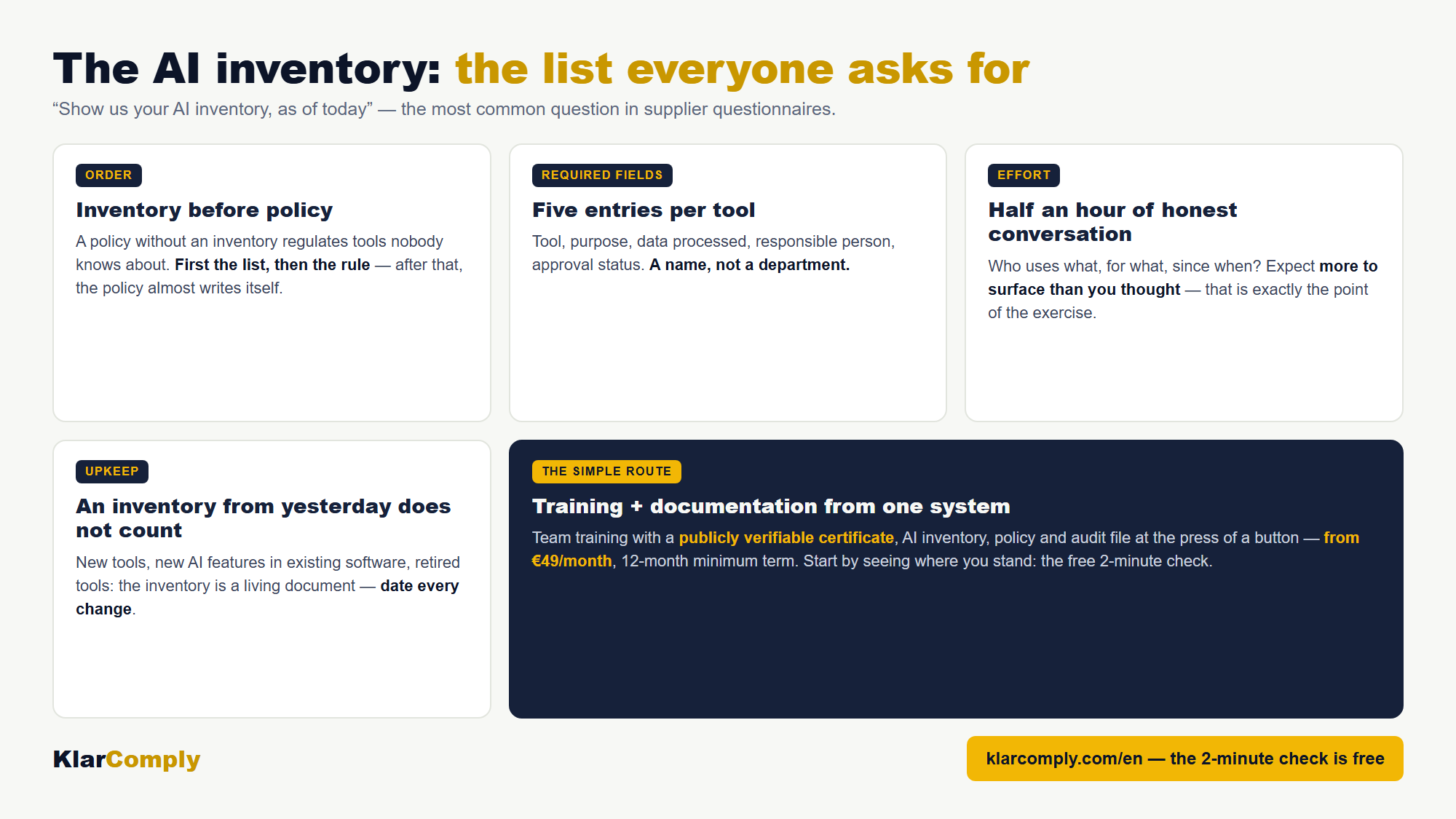
Is an AI inventory legally required?
Not in this form. The regulation does not oblige deployers to keep a register with prescribed fields, and anyone telling you otherwise is overselling. What is true is narrower and more useful: it is the only practical way to satisfy the duties that are imposed. You cannot classify what you have not identified, you cannot label what you do not know is generating images, and you cannot evidence what you have not written down.
Two things make it non-optional in practice. Article 26 puts a set of obligations on deployers that presuppose you know what you are running. And supplier questionnaires now ask for the register by name — usually as question one or two, before anything about training.
A note for companies outside the EU
Under Article 2 the regulation reaches providers and deployers established in a third country where the output produced by the AI system is used in the Union. That has a direct consequence for the inventory: for every tool, record whether its output reaches the EU. A generated image on a page served to EU visitors, an AI-drafted email to an EU customer, a screening result acted on by an EU subsidiary — all of those are output used in the Union. Add it as a column and the awkward question answers itself.
The eight fields
Fewer than these is not enough to answer the questions you will be asked. More than these does not get maintained, in our experience without exception.
| Field | Why it is needed |
|---|---|
| Name and provider | Identification, and the starting point for reviewing the contract and the provider's own terms |
| Purpose of use | Specific, not "various tasks" — the purpose is what determines the risk class |
| Department and responsible person | Who can give an account when the question comes |
| Risk class with reasoning | The most valuable field in the register: it evidences that you assessed rather than guessed |
| Categories of data processed | The interface with data protection — and the field your DPO will want |
| Approval status and date | Shows that a process exists rather than a habit |
| Contractual basis | Business agreement, data processing agreement, or a free personal account |
| Date of last review | Answers "when did you last look at this?" without you having to think |
Two optional columns earn their keep quickly: whether the tool generates images, audio or video (that is your Article 50 exposure in one glance), and whether its output is used in the Union.
The real problem: shadow AI
The hard part is not filling in the table. It is finding what goes in it. In almost every organisation there are AI tools running that the management does not know about: personal accounts used for work, browser extensions, and AI features that arrived by update in software bought years ago for something else.
A reliable rule of thumb: a first proper stocktake turns up two to three times as many tools as the management expected. That is not a sign of a badly run company. It is what happens when useful tools become free and instant.
Five routes that complement each other
- A team survey with an explicit amnesty. By some distance the most effective single measure. State plainly that naming a previously unknown tool carries no consequence of any kind. Without that, nobody names anything, and you will build your compliance on a fiction.
- Invoices and card statements for the last twelve months. Subscriptions give themselves away through the accounts long before anyone admits to them.
- Browser extensions on work devices. Quick to check, and consistently productive.
- Release notes of software you already run. AI features retrofitted into existing products are the most common blind spot there is — the tool was approved years ago, the AI in it never was.
- Ask departments separately rather than the company as a whole. Marketing, sales, HR, support and finance each have their own tools, and a company-wide email gets a company-wide shrug.
Amnesty wording that actually works
"We are building an overview of the AI tools in use. Anything named now counts as helping to solve the problem, not as breaking a rule — there will be no consequences of any kind. From [date] our approval process applies to anything new."
The second sentence matters as much as the first. An amnesty without an end date reads as permanent permission.
Classifying without over-engineering it
Most entries in a normal company's register resolve to "minimal risk" and take thirty seconds. The regulation's structure makes that easy if you take the questions in order:
- Is it a prohibited practice under Article 5? For ordinary businesses this is a short list, but emotion inference in the workplace is on it and is occasionally sold as a productivity feature. If yes: stop using it.
- Is it high-risk under Annex III? For SMEs, realistically only two areas come up: employment (anything sorting applications, evaluating performance or allocating tasks) and creditworthiness. If yes: document it and take legal advice — the deadline moved to December 2027, the classification should not wait.
- Does it trigger a transparency duty under Article 50? Chatbots, generated images, synthetic voice. This applies now and carries a fine.
- Otherwise: minimal risk. Record the reasoning in one sentence and move on.
Write the reasoning even where the answer is obvious. "Translation tool, no personal data, no decision about people, minimal risk" is a complete and defensible entry. A blank cell is not.
How often it has to be maintained
An inventory that goes quiet after the initial sweep is worthless — and in an audit it is worse than none, because it documents that you knew what to do and stopped.
- Event-driven: every new tool goes in before it is approved, not after
- Quarterly: a short review, about fifteen minutes
- Annually: a full pass including risk classes and contracts
- On a change in the law: revisit the affected entries and note the date you did
When a tool is dropped, do not delete the entry. Mark it as ended with a date. An audit or a claim can concern a period in the past, and a deleted row cannot defend a decision you made in it.
The three questions in the review meeting
Expect exactly these, from a regulator and from a corporate customer's procurement team alike. Prepare the answers once and they stop being stressful:
- "How do you know the list is complete?" → your collection method plus the approval process that keeps it complete
- "When did you last review it?" → the date in the last-review field
- "How did you arrive at that risk class?" → your documented reasoning
Anyone who can answer all three calmly, with their own system open in front of them, ends the conversation in a few minutes. That is the entire purpose of the document.
What the inventory feeds
It is worth being explicit about why this comes first, because it is not paperwork for its own sake:
- Training — you cannot scope who needs which level until you know which tools exist in which department
- Labelling — the "generates images, audio or video" column is your Article 50 to-do list. Free labels are on our AI labels page
- Your internal policy — the approved-tools section is simply a view of the register
- Data protection — the data-categories column is what your record of processing activities needs anyway
- Sales — the register is what you send when a customer's questionnaire arrives, which is usually the deadline that turns out to be real
If you would like a structured starting point rather than a blank spreadsheet, our compliance kit includes the register with the eight fields, the risk-class prompts and the review log already set up.
Frequently asked questions
Does an AI inventory have to contain particular fields?
No field catalogue is prescribed by law. Eight have proven sufficient in practice: name, provider, purpose, responsible person, risk class with reasoning, data categories, approval status, contractual basis and date of last review.
Does ChatGPT count as an AI system that belongs in the inventory?
Yes. As soon as it is used for work it belongs in the register, with a note on whether it is a business agreement or a free personal account. The latter is usually a problem for work content, because there is no data processing agreement behind it.
What is shadow AI?
AI tools in use within the organisation without the management knowing — personal accounts used for work, browser extensions, and AI features that arrived by update in software bought for something else.
How often does the inventory have to be updated?
Event-driven for every new tool before approval, a short quarterly review, and one full annual pass including risk classes and contracts. Record the date of each pass.
We are based outside the EU. Do we still need one?
If any of your AI output is used in the Union, the regulation reaches you under Article 2 and the register is how you show which activity that concerns. Add a column recording, per tool, whether its output reaches the EU.
Where does your company stand?
The free quick check walks through ten points — AI inventory, training status, transparency duties, responsibilities. Two minutes, no sign-up, an honest result and your concrete gaps.
Start the quick check — freeArticle 26 EU AI Act — obligations of deployers
Article 2 EU AI Act — scope
Article 5 EU AI Act — prohibited practices
Regulation (EU) 2024/1689 — official consolidated text, EUR-Lex
European Commission — regulatory framework for AI