AI and employee representation: the principle, and where national law takes over
This is the page on which we can give you least certainty, and saying so is more useful than pretending otherwise. Participation rights vary more between member states than almost any other area of European employment law. What holds everywhere is the principle: employees and their representatives are involved before a system capable of monitoring them is introduced. How much force that principle carries depends entirely on where your people sit.
By Patrick de Kathen, Founder of KlarComply · Reviewed on
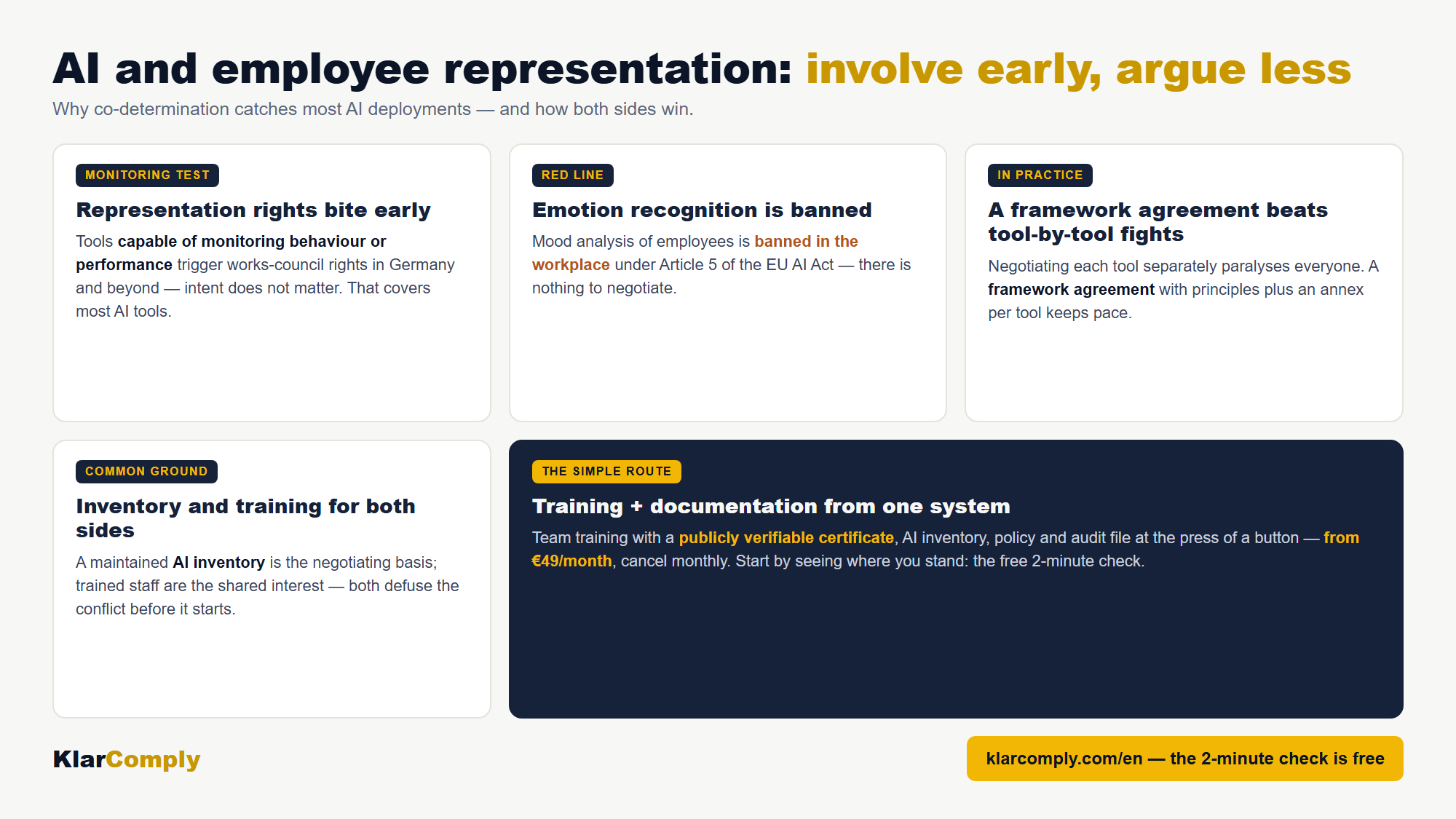
Why this page is structured differently
Most of the AI Act is a regulation. It applies directly and identically in every member state; there is no national transposition that could diverge from it. Only the designation of the market surveillance authority is a national matter.
Employee participation is the opposite. It rests on national law, and national law here ranges from a legally enforceable right of co-determination to little more than a duty to inform. A page that named one national provision and treated it as the answer would be misleading for most readers. So this one works from the principle downwards.
The honest summary in four sentences
- There is an EU-wide floor: Directive 2002/14/EC establishes a general framework for informing and consulting employees in undertakings above a size threshold set by each member state.
- Above that floor, national law diverges sharply. Germany, Austria, the Netherlands and the Nordic states give employee bodies rights that go considerably further, up to genuine co-determination over the introduction of technical systems.
- In several of those systems, a system that is merely capable of monitoring conduct or performance triggers the right. No monitoring intention is needed, and most AI tools with individual user accounts cross that line.
- In the UK, Ireland and the United States the position is different again, but nothing there removes the practical need to communicate a policy properly before relying on it.
If your people are in more than one country, the safe planning assumption is the strictest regime among them.
The floor: Directive 2002/14/EC
The directive establishes a general framework for informing and consulting employees in the European Union. Its core is a right to information on the situation and probable development of employment within the undertaking, and to information and consultation on decisions likely to lead to substantial changes in work organisation or in contractual relations.
Two features matter for AI. First, consultation has to take place at a time, in a fashion and with a content appropriate to allow the employee representatives to meet the employer and obtain a response to any opinion they formulate, which means before the decision is final, not after the contract is signed. Second, the directive sets minimum requirements only; member states may and do provide more favourable arrangements.
The practical reading: an AI rollout that changes how work is organised, how output is measured, or how tasks are allocated is the kind of decision the directive was written for. Whether it triggers a hard veto depends on national law. Whether it triggers a conversation does not.
Where national law goes further
Without turning this into a country-by-country handbook, four patterns recur across Europe and it is worth knowing which one you are in.
| Pattern | What it looks like | Practical consequence for an AI rollout |
|---|---|---|
| Co-determination over technical systems | The representative body has an enforceable right to agree the introduction and use of systems capable of monitoring conduct or performance; disputes go to a formal resolution body | You negotiate an agreement before rollout. Introducing the tool without one can be stopped, including by interim relief. |
| Consent or advice on major changes | The works council has a right to advise on defined decisions, with the ability to challenge a decision taken against its advice | Timing is critical. The advice has to be sought early enough to influence the decision. |
| Information and consultation only | The 2002/14/EC minimum, sometimes triggered only on employee request | You inform and consult, and you record that you did. There is no veto. |
| No standing body | No works council exists, or none has been requested | Data protection duties and ordinary employment law still apply in full. See the section below. |
Collective agreements add a further layer in several countries and can impose obligations that the statute does not. If a sectoral agreement applies to you, read it before you read anything else, it is the source most often forgotten.
The principle that survives every jurisdiction
Strip away the national machinery and one rule remains, and it is the rule worth designing around:
Involve people before you introduce a system capable of monitoring them
Not because a particular provision says so in your country, but because the alternative fails in every country. A system introduced without involvement is worked around, distrusted, and, where a right did exist, vulnerable. A system introduced with involvement is used openly, which is the only condition under which you find out what it is actually doing.
Nearly every AI tool with individual user accounts generates data capable of showing who did what, when, and how much. You may have no intention of looking. The data exist regardless, and in several jurisdictions that alone is the trigger.
Anyone opening a conversation with employee representatives by arguing that the tool is not meant for monitoring is starting on the weakest available ground. In the strict jurisdictions that argument is settled against employers. In the permissive ones it is beside the point.
What is not up for negotiation
This boundary belongs in the first meeting, because it saves both sides time. Even under the strictest national regimes, some things stay with the employer.
- The business decision itself. Whether to use AI at all is the employer's. What is shared is the how.
- Choice of provider is generally not subject to a separate right of approval, though it is affected indirectly, because the configuration is negotiable and a provider that will not permit a required setting effectively drops out.
- Commercial terms such as price and contract length.
- Use with no individual attribution at all. Where a tool generates no data attributable to individual employees, the monitoring trigger is doubtful. That situation is rarer than it sounds, and whether anonymous shared use truly excludes the criterion is contested.
A sequence that works
- Inform early. As soon as introduction is being considered, not once it has been decided. A two-page note is enough: what the tool is to do, which areas it affects, what data it generates.
- Establish the facts together. What logs does the system produce, who can see them, how long are they kept? Those three questions decide ninety per cent of the negotiation. Obtain the answers from the provider beforehand, in writing.
- Draft first. Whoever writes the first draft shapes the outcome. A fair draft moves faster than a maximal one.
- Negotiate. Expect two to four meetings for a single tool, more for a framework agreement.
- Conclude, announce, train. The agreement has to be known by the people it covers, or it changes nothing.
- Review. A date six months out at which both sides may adjust takes the pressure off getting everything perfect immediately.
A framework agreement rather than one per tool
Negotiate separately for every new tool and you negotiate permanently. A framework agreement on AI settles the principles once, purpose limitation, no performance evaluation, logging, retention, involvement, and adds individual tools through a schedule under a shortened procedure with a fixed deadline.
That is the better route for both sides. The representative body keeps control of the principles; the business stays able to act. Without it, departments route around the procedure and you get shadow AI, see shadow AI in the workplace.
The agreement: twelve components
These hold up whether the document is a formal works agreement, a collective arrangement or a unilateral policy adopted voluntarily. The label changes; the content does not.
- Scope: who, where and which tools are covered
- Purpose: what the tool is used for, stated exhaustively
- Purpose limitation and no performance evaluation: the central clause: no monitoring of conduct or performance, no individual analysis without a specific cause and involvement
- Log data: what is generated, who has access, retention period, automatic deletion
- No automated individual decisions: by reference to Article 22 GDPR; decisions about people are taken by people
- Permitted and prohibited inputs: specific, with examples from your own business
- Labelling of AI-generated content, externally and internally
- Training: entitlement, scope, release from other duties to attend
- Procedure for new tools: a shortened route with a deadline
- Handling mistakes: the reporting route, with express freedom from sanction for a prompt self-report
- Inspection rights of the representative body: sight of the configuration and of any analyses, without access to third-party content
- Term, termination, continuing effect, review date
The clause that is argued over most
The prohibition on performance analysis. Wording that holds up in practice:
“Log data arising from use will not be analysed for the purpose of monitoring conduct or performance. Analysis attributable to an individual is permitted only where there is a specific, documented suspicion of a serious breach of duty, and takes place with the involvement of the employee representatives. Analysis for the purpose of system security is carried out exclusively in anonymised or aggregated form.”
The last sentence is the one IT depends on, without it they cannot secure the estate. Offering it from the outset saves a meeting.
What happens if you skip the involvement
The consequences depend on the jurisdiction, and they range from awkward to expensive. Four categories, roughly in order of severity:
- Injunctive relief. In the stricter systems the representative body can have the introduction or continued use stopped, in urgent cases by interim relief. That lands on a tool already rolled out and in daily use.
- Measures based on the system may not hold. Where a system was introduced in breach of a participation right, decisions taken on the strength of it, a warning, a dismissal, a performance rating, can be vulnerable in employment proceedings.
- Admissibility of what the system produced. Whether evidence obtained through a system introduced in breach may be used is contested and courts do not answer it uniformly. It is not something to rely on either way.
- A data protection consequence. Under Article 88 GDPR, member states may allow collective agreements to serve as the vehicle for rules on processing employee data, and several make direct use of that. Where no agreement exists, the legal basis for the processing may be missing too. That makes this more than a question of employment representation.
What the AI Act itself requires
The regulation adds one duty of its own that does not depend on any national participation regime. Where deployers put a high-risk AI system into use at the workplace, they inform the workers concerned and their representatives in advance that they will be subject to it. That duty stands alongside national participation rights; it does not replace them, and it does not depend on a representative body existing.
AI systems in the employment field, pre-selection of applications, performance evaluation, task allocation, decisions on promotion or termination, fall within the high-risk area under Annex III. The corresponding obligations were postponed by the Digital Omnibus to 2 December 2027 for standalone systems and 2 August 2028 for AI embedded in regulated products.
The postponement changes nothing about employee involvement. National participation rights apply today. So if you are introducing a system of that kind, both layers arrive together: involvement now, AI Act high-risk obligations later. Do the classification immediately in any case and record it, see classifying AI risk.
Where no representative body exists
In companies without one, the participation question falls away. The subject does not. Three things remain:
- Data protection law applies unchanged. Log data about employees are personal data. Purpose limitation, retention periods and transparency under Article 13 GDPR have to be settled, just unilaterally rather than negotiated.
- The AI Act requires information. Before a high-risk system is used at the workplace, the workers concerned are informed. That duty does not depend on a representative body existing.
- Acceptance does not appear by itself. What a representative body would otherwise insist on, purpose limitation, no performance analysis, deletion periods, is worth writing into your policy voluntarily. Tell people their inputs will not be used to assess them and you get use that happens openly, which is the only kind you can supervise.
If a body is later established, a rule that is already documented cleanly is the best possible starting point for the negotiation, and it spares you the retrospective unpicking of a system already in production.
Cross-border teams
Do not write one agreement per country. The substance, purpose limitation, log data, prohibited inputs, labelling, incident handling, is the same everywhere. Put the differences in a short annex: which body applies in which country, which national data protection specifics bite, which language version governs. This mirrors the approach on the internal AI policy, and for the same reason: one substance, many procedures.
Where a European Works Council exists, check its agreement as well. Transnational rollouts are frequently within its remit even where each national body also has to be consulted.
What you do not need
- Not an agreement per tool. A framework with schedules is enough and is faster.
- Not a lawyer in every meeting. Legal review of the framework is worthwhile. For the schedules it rarely is.
- Not a formal dispute procedure as a first step. It costs time and money and rarely produces an outcome that was not negotiable.
- Not an argument about whether the tool is capable of monitoring. In the strict jurisdictions that argument is lost before it starts, and it costs two weeks of goodwill.
Where a representative body exists, involving it is worth doing even where you are not obliged to. A rule developed jointly gets carried; one imposed from above gets worked around. How such a rule is built is on writing an internal AI policy; the labelling question can be dealt with in minutes using the free AI labels. Where you stand overall is answered by the free quick check.
Frequently asked questions
Do employee representatives have to approve the introduction of AI?
It depends entirely on the country. Directive 2002/14/EC sets an EU-wide floor of information and consultation, but several member states go much further and give representative bodies an enforceable right of co-determination over systems capable of monitoring conduct or performance, in some of them the mere capability is enough, with no monitoring intention required. Nearly every AI tool with individual user accounts meets that description. In jurisdictions with no standing body there is no approval right, but data protection law and ordinary employment law still apply.
When do employee representatives have to be informed?
As early as the planning stage. Directive 2002/14/EC requires consultation at a time and with a content that allows representatives to formulate an opinion and obtain a response, which means before the decision is final. Several national systems are more explicit still. Informing the body once the contract is signed skips the stage that matters and starts the conversation with a grievance.
What belongs in an agreement on AI?
Scope; an exhaustive statement of purpose; purpose limitation and a prohibition on performance analysis; rules on log data with deletion periods; a prohibition on automated individual decisions; permitted and prohibited inputs; labelling; training; a procedure for new tools; handling of mistakes; inspection rights; and term, termination and a review date.
What happens if we skip the involvement?
In the stricter jurisdictions the representative body can have introduction or continued use stopped, including by interim relief, and measures taken on the strength of the system may not hold against employees. Whether evidence obtained through such a system may be used is contested. Separately, where a collective agreement was to serve as the vehicle for processing employee data under Article 88 GDPR, its absence can leave the processing without a basis.
Do we need a separate agreement for every new AI tool?
No, and it is not practical. A framework agreement settling the principles once, with a schedule per tool under a shortened procedure and a fixed deadline, works better for both sides. Without that structure, departments route around the procedure.
Does any of this apply if we only use ChatGPT?
Once use is for work and runs through individual accounts, attributable usage data exist, which is normally enough to meet the monitoring criterion in the stricter jurisdictions. Whether purely anonymous shared use without individual accounts excludes it is contested. Involvement is also advisable because the accompanying rule on how the tool may be used can itself fall within participation rights on workplace conduct.
Does the AI Act require us to tell employees anything?
Yes, in one situation. Where a deployer puts a high-risk AI system into use at the workplace, the workers concerned and their representatives are informed in advance. That duty stands alongside national participation rights and does not depend on a representative body existing.
High-risk obligations were postponed. Can we wait?
Not on this. The postponement to December 2027 and August 2028 concerns the AI Act's high-risk obligations. National participation rights apply today, and so does the information duty for high-risk systems at the workplace once those provisions bite. The classification itself should be documented now.
Where does your company stand?
The free quick check walks through ten points, AI inventory, training status, transparency duties, responsibilities. Two minutes, no sign-up, an honest result and your concrete gaps.
Start the quick check, freeDirective 2002/14/EC, general framework for informing and consulting employees
Article 26 EU AI Act, deployer obligations, including information to workers
Article 6 EU AI Act, classification as high-risk
Article 22 GDPR, automated individual decision-making
Article 88 GDPR, processing in the employment context
Regulation (EU) 2024/1689, official consolidated text with Annex III