AI in the car repair shop: faster in the office, safe at the lift
In a repair shop AI helps in two places: in the office (quotes, customer letters, reviews) and increasingly in diagnostics. The risks sit exactly where safety and money are at stake: invented technical values from AI summaries, and pricing or customer data in open tools.
By Patrick de Kathen, Founder of KlarComply · Reviewed on
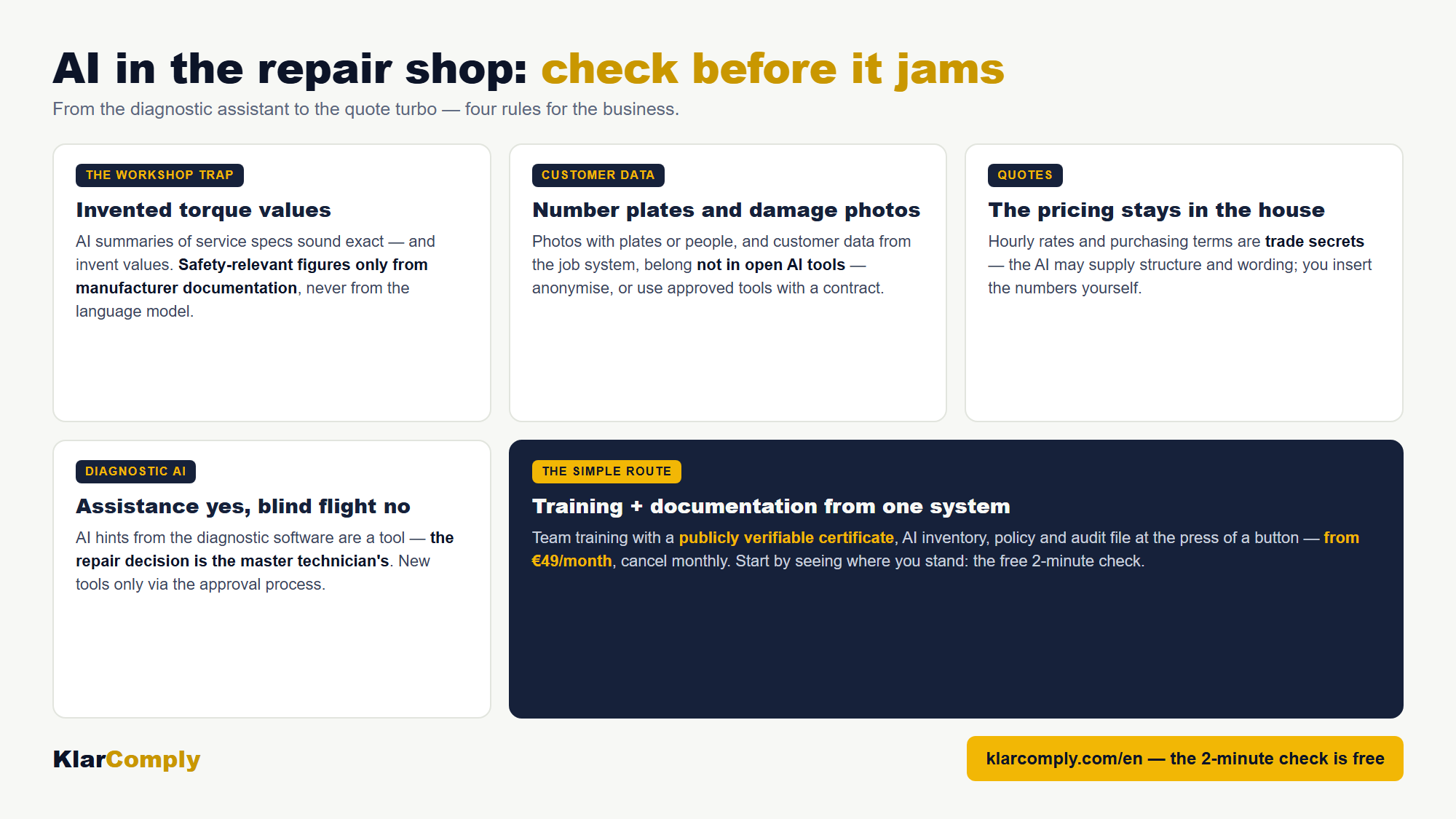
The workshop trap: invented torque values
Language models answer technical questions with impressive precision, including when they invent the answer. A torque “per the standard” that does not exist, a fill quantity from a hallucinated data sheet: in a workshop such values are not a cosmetic flaw but a safety risk with liability attached.
The iron rule at the lift
Safety-relevant values come exclusively from manufacturer documentation and repair databases: never from a language model. AI may summarise and translate; every value is checked against the original source before it goes into a work instruction or onto a vehicle.
Diagnostic AI: assistance yes, blind flight no
Modern diagnostic systems ship with AI features that interpret fault patterns and suggest repair paths. Nothing wrong with that, as long as one thing stays clear: the suggestion is a tool, the repair decision is the master technician's responsibility. New diagnostic or workshop tools enter the business through the approval process (data protection, contract, classification), not through a mechanic's free download, that is how shadow AI is avoided.
Customer data: number plates, damage photos, job history
A damage photo with a readable number plate or a person in frame is personal data; the job management system holds names, addresses and vehicle data. The same line as everywhere applies: not into open AI tools. The complaint reply or the service-due reminder can be drafted anonymised, name and plate go back in afterwards.
Quotes: the pricing stays in the house
Hourly rates, purchasing terms and margins are trade secrets, and their legal protection under the EU Trade Secrets Directive requires that you take reasonable steps to keep them secret. The AI may supply structure and wording for a quote; you insert the numbers yourself. Copying the full calculation into a public tool “just to check it” risks more than a data leak.
Public face: reviews and social media
AI-drafted replies to reviews are permitted and sensible, friendly, factual, without customer data. For images the labelling line applies: a photorealistic AI image of the “workshop at night” that could be taken for a photo is disclosed as an AI image (Article 50 of the EU AI Act, since 2 August 2026); recognisable illustrations stay free.
What fleet customers and insurers now ask
Whoever works for fleets, leasing companies or insurers increasingly sees AI questions in framework contracts and supplier questionnaires: tool list, responsible person, training records. A maintained AI inventory plus a record per person answers that in two minutes.
Where to start
Free 2-minute check; training (40-50 minutes per person, with a publicly verifiable certificate), inventory, policy and audit file in the subscription from €49/month, 12-month minimum term.
Frequently asked questions
May I use service values from an AI answer?
No. Safety-relevant values such as torque figures or fill quantities come exclusively from manufacturer documentation and repair databases. Language models invent such values convincingly, AI may shorten the path to the source, it does not replace the source.
Are photos with number plates a data protection issue?
A readable plate makes the vehicle attributable to a person, which makes the photo personal data. It does not belong in open AI tools; in approved systems with a contract, for workshop documentation, it is unproblematic.
Where does your company stand?
The free quick check walks through ten points, AI inventory, training status, transparency duties, responsibilities. Two minutes, no sign-up, an honest result and your concrete gaps.
Start the quick check, freeArticle 50 AI Act, transparency obligations
Directive (EU) 2016/943, trade secrets protected only by reasonable steps