AI in the law firm: confidentiality first, then efficiency
Hardly any sector benefits as directly from language models as legal practice, and hardly any has harder guardrails: professional secrecy carries criminal sanctions in Germany, and the most famous AI accident in legal history happened, of all people, to a lawyer. Together, the two yield a clear operating manual.
By Patrick de Kathen, Founder of KlarComply · Reviewed on
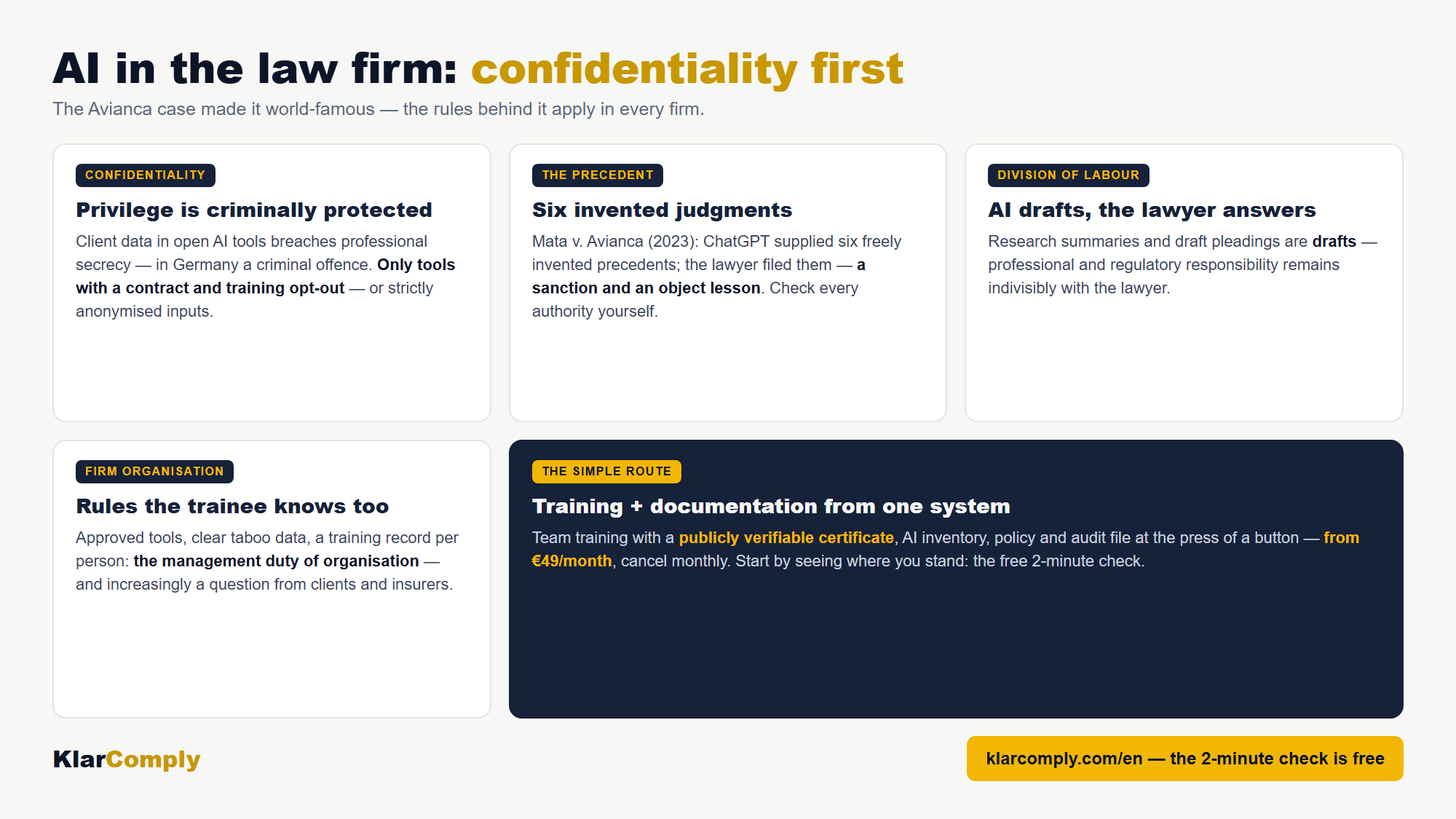
The first line: client confidentiality
For holders of professional secrets, handling client data is not a mere data-protection question: in Germany, breaching private secrets is a criminal offence (Section 203 Criminal Code), and German bar rules demand particular care when engaging service providers (Section 43e Federal Lawyers' Act), bar rules elsewhere impose equivalent duties of confidentiality and supervision. A draft pleading with names, file references and facts in a public free tool is therefore not an efficiency gain but a professional risk.
In practice that means: AI tools only on a contractual footing (data processing agreement, confidentiality commitments, training switched off), or with rigorously anonymised inputs, where the facts are abstracted far enough that no inference to the mandate is possible.
The second line: the Avianca lesson
Six invented precedents
Mata v. Avianca (S.D.N.Y. 2023): a New York lawyer filed a brief that ChatGPT had supported with six precedents, all six freely invented, with plausible citations and quotes. A hearing and a sanction of 5,000 US dollars followed. The lesson is not “no AI”, but: every authority is checked against the original before it goes into a filing. Language models are drafting aids, not research authorities.
Where AI carries safely in a firm
| Use | Line |
|---|---|
| Drafting and structuring help for pleadings | With anonymised facts or in vetted legal-tech tools; professional review remains indivisibly with the lawyer. |
| Summarising your own documents | Only in tools with a contract; every “addition” by the AI is a hallucination and is thrown out. |
| Firm marketing, client newsletters | Unproblematic, ordinary texts carry no labelling duty; fact-check as with any text. |
| Research results, citations, case law | Distrust on principle: verify at the original (database, EUR-Lex, official reports). |
The third line: organisation you can show
Clients, especially companies with compliance duties of their own, increasingly ask their firms about their AI practice; professional indemnity insurers are following. The answer is the same organisation the AI Act suggests: a tool inventory, a firm policy (permitted tools, taboo data, review duties), and training records per person, from partner to trainee. Article 4 of the EU AI Act has required firms, as deployers, to support their team's AI literacy since February 2025; the provision carries no separate fine, but the management's duty of organisation exists independently of it.
Where to start
Free 2-minute check; team training (40-50 minutes per person) with a publicly verifiable certificate, inventory, policy and audit file in the subscription from €49/month. The legal analysis of the individual case naturally remains your domain, we supply the organisation underneath.
Frequently asked questions
May lawyers use ChatGPT?
Yes, but not with client data in public free tools: professional secrecy is criminally protected in Germany (Section 203 Criminal Code), and bar rules elsewhere impose equivalent duties. Permissible are tools on a contractual footing with training switched off, or rigorously anonymised inputs with no inference to the mandate.
What does Mata v. Avianca teach?
ChatGPT supplied a New York lawyer with six freely invented precedents complete with plausible citations; he filed them unchecked, a sanction of 5,000 US dollars followed (S.D.N.Y. 2023). The lesson: every authority is verified at the original before it goes into a filing.
Where does your company stand?
The free quick check walks through ten points, AI inventory, training status, transparency duties, responsibilities. Two minutes, no sign-up, an honest result and your concrete gaps.
Start the quick check, free