AI in the trades business: save office hours, secure contracts
In the trades, the AI payoff is in the office: quotes, payment reminders, customer letters and social media posts in a fraction of the time. The risks are manageable once three lines are in place, and a fourth point can now help decide contracts: the AI section in the general contractor's subcontractor questionnaire.
By Patrick de Kathen, Founder of KlarComply · Reviewed on
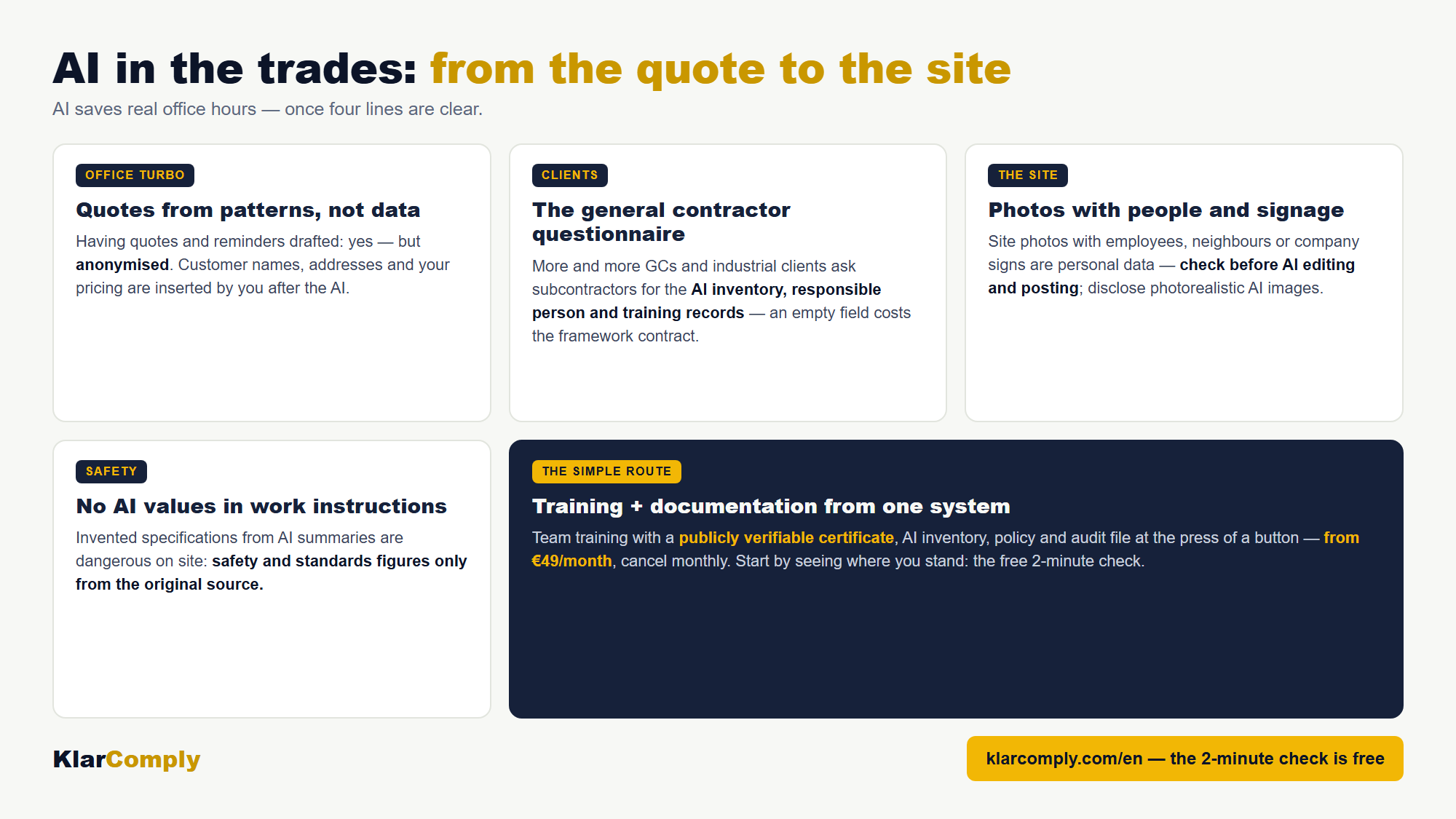
The office turbo: patterns, not data
The AI drafts the quote to “a regular customer for a bathroom renovation” admirably, it needs neither the name nor your prices for that. The safe way of working: anonymised request, numbers and names added by hand afterwards. Your pricing (hourly rates, purchase prices, mark-ups) is a trade secret; its protection under the EU Trade Secrets Directive depends legally on you taking reasonable steps to keep it secret, careless inputs into open tools eat away at exactly that.
The new contract filter: questionnaires from GCs and industry
Why this now means money
General contractors and industrial clients pass their own compliance duties down the chain: prequalifications and subcontractor questionnaires increasingly ask for the AI tool list, the responsible person and training records. An empty field there quickly becomes the difference between a framework contract and a rejection, long before any authority asks.
The good news: for a trades business the answers are produced in manageable time, an AI inventory, a short policy, a record per person. Set up cleanly once, every further questionnaire is answered in minutes.
Site photos: people, signs, neighbouring properties
Photos from the site are daily routine, for documentation, warranty and Instagram. As soon as employees, neighbours or other firms' signage are recognisable, they are personal data: check before AI editing and publication, pixelate or obtain consent in case of doubt. And where the AI produces a photorealistic “before and after” that could be taken for a photo, the AI notice belongs on it (Article 50 of the EU AI Act, since 2 August 2026).
Safety: no AI values in work instructions
AI summaries of standards, installation guides or manufacturer specifications sound precise, and invent values in case of doubt. On a building site that is dangerous: safety and standards figures come from the original source; at most, the AI may shorten the path there. Whatever cannot be found in the source is thrown out.
Three rules for the whole business
| Rule | Why |
|---|---|
| Work content only in approved tools | The personal free account lacks the contract that protects your data. |
| Never enter customer data or pricing | Data protection and trade-secret protection, both hang on this one habit. |
| Honest reporting stays consequence-free | A reported mishap is a solved problem; a concealed one is a risk. |
Where to start
Free 2-minute check. For the questionnaire moment: training with a publicly verifiable certificate per person plus inventory, policy and audit file in the subscription from €49/month.
Frequently asked questions
Why is my general contractor suddenly asking for AI evidence?
Larger clients pass their own compliance duties down the chain, as they did before with occupational safety and data protection. Typically requested: tool list, responsible person and training records. Set up cleanly once, every further questionnaire is answered in minutes.
May I write quotes with ChatGPT?
Yes, anonymised: the AI receives the structure (“quote for a bathroom renovation for a regular customer”); your pricing and the customer data are inserted by you afterwards. Hourly rates and purchase prices are trade secrets and belong in no open tool.
Where does your company stand?
The free quick check walks through ten points, AI inventory, training status, transparency duties, responsibilities. Two minutes, no sign-up, an honest result and your concrete gaps.
Start the quick check, freeArticle 50 AI Act, transparency obligations
Directive (EU) 2016/943, trade secrets protected only by reasonable steps