The internal AI policy: nine components that belong in it
Most AI policies do not fail because they are legally unsound. They fail because nobody reads them. Here is what belongs in one — and how to write it so that it changes what people actually do on a Tuesday afternoon.
By Patrick de Kathen, Founder of KlarComply · Reviewed on
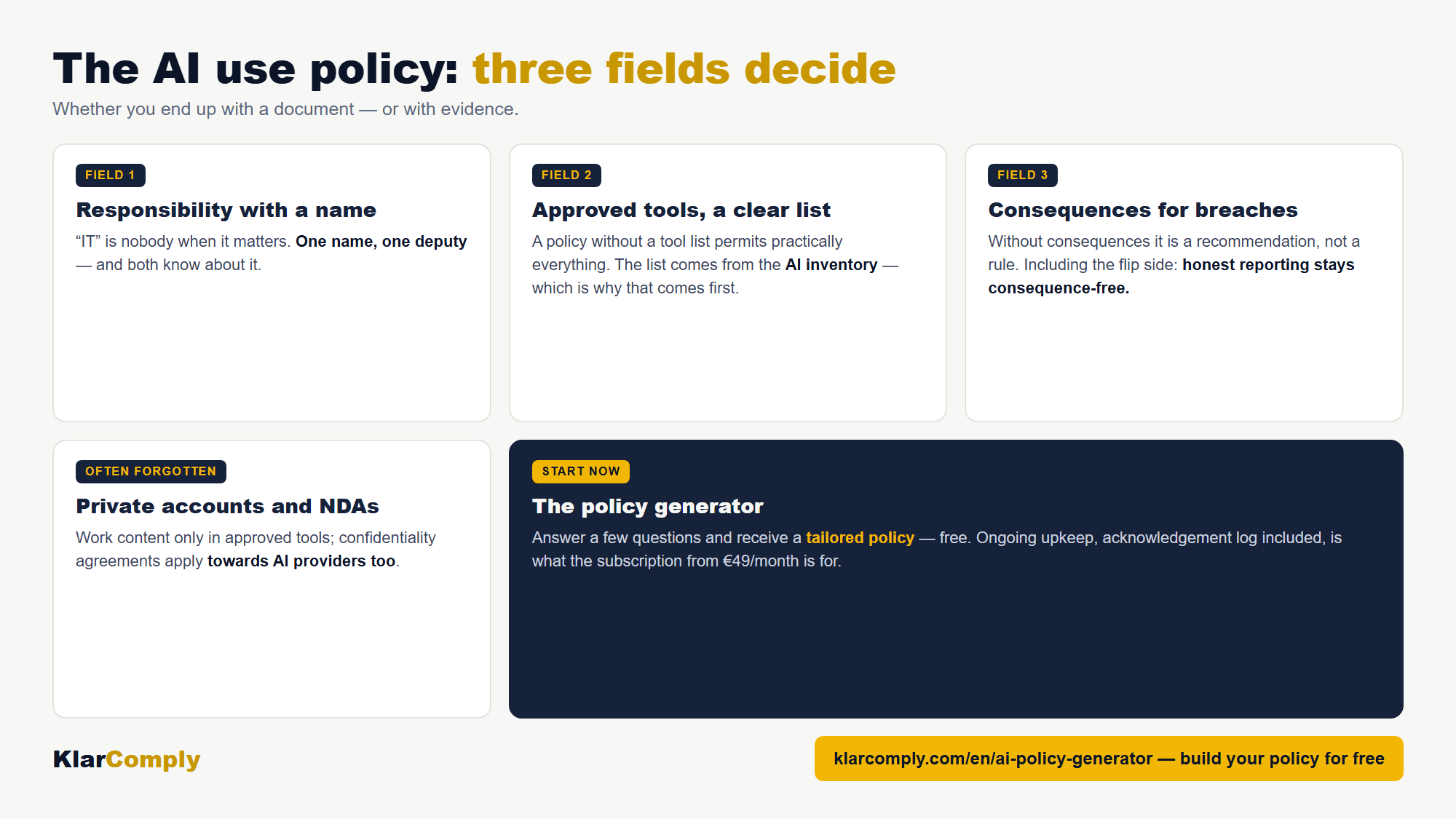
What a policy has to achieve
Three things at once. It has to make employees capable of acting, protect the company legally, and be comprehensible to an outsider — a customer's procurement team, an auditor, a regulator. Most drafts manage the second and third and fail at the first.
A working test: if a new colleague reads it in ten minutes and afterwards knows what she is allowed to do, it is a good policy. If she finds fifteen pages of legal prose, she will not read it, and you have a document rather than a rule.
The nine components
- Scope — who it applies to and which tools it covers. Say explicitly whether it binds contractors and agencies, because Article 4 of the AI Act extends to persons acting on your behalf.
- Approved tools — an exhaustive list, or a reference to the AI inventory. Do not maintain the same list twice.
- Prohibited inputs — personal data, trade secrets, third-party information held in confidence, security credentials, unpublished financial figures.
- Review duty — human checking before anything has an external effect. This is also the clause that carries the Article 50(4) editorial-responsibility exemption.
- Labelling rule — when and how AI content is disclosed under Article 50. Name the channels: website, social media, phone line, brochures.
- Approval process — how a new tool is requested and cleared, with a stated turnaround. Without a turnaround, people route around the process.
- Responsibilities — who decides, who is the point of contact, who holds editorial responsibility for published text.
- Incident procedure — what to do when something confidential went in anyway.
- Consequences of breach — the employment-law framework, proportionately drafted and consistent with your other policies.
Three techniques that make the difference
- Concrete instead of abstract. Not "avoid sensitive data" but "no customer names, no pricing calculations, no application documents". Name three examples from your own business. That is the difference between a policy that is read and one that is filed.
- Positive where possible. "For drafting text, use ChatGPT Team" works better than a list of prohibitions. People follow a route more reliably than they avoid a fence.
- Examples instead of definitions. One wrong and one right example side by side explains more than a paragraph of theory, and it survives translation into the languages your team actually thinks in.
The section that is missing almost everywhere
The incident rule. What happens when somebody has accidentally pasted customer data into a public AI tool? Without a clear, blame-free procedure, nobody reports it — and you never find out.
Wording that works: "Anyone who has inadvertently entered confidential data must report it to the AI lead without delay. A prompt self-report carries no employment consequences. We will then assess together whether a notification duty arises under data protection law."
The second sentence is the load-bearing one. Without it you receive no reports — and without reports you cannot meet the 72-hour notification deadline in Article 33 GDPR, which runs from the moment the controller becomes aware, not from the moment somebody feels ready to mention it.
Trade secrets: the argument nobody makes
Under Directive (EU) 2016/943, information qualifies as a trade secret only where it is secret, has commercial value because it is secret, and has been subject to reasonable steps under the circumstances to keep it secret. That third limb is a test you either pass or fail, and it is assessed after the fact, in a dispute, by a court.
A written AI policy that names which categories of information must not be entered into AI tools is one of the cheapest "reasonable steps" available. Its absence works the other way: if staff routinely paste pricing models and customer lists into a public chatbot and no rule ever told them not to, the argument that you took reasonable steps becomes considerably harder to make. The UK regulations implementing the same directive apply the same test, and US trade secret law asks a materially similar question about reasonable measures.
This is worth spelling out because it converts the policy from a compliance cost into an asset-protection measure — which is usually the version that gets budget approved.
Consulting the workforce
Whether formal consultation is required depends on where your people are, and the answer differs sharply across Europe. Some general points hold everywhere:
- Where a works council or equivalent employee representation exists, rules of this kind normally require consultation or co-determination. In several member states a system that is merely capable of monitoring performance or conduct triggers the right — no monitoring intention is needed, and AI tools cross that line faster than most managers expect. Directive 2002/14/EC sets the EU-wide floor for information and consultation; national law goes considerably further in Germany, Austria, the Netherlands and the Nordics.
- In the UK and Ireland, there is generally no works council in the continental sense, but information and consultation regulations may apply, and employment law still requires that a policy be communicated properly before it can support disciplinary action.
- Where AI tools process employee data, GDPR obligations apply independently of any consultation requirement — a lawful basis, transparency to staff, and in many cases a data protection impact assessment.
Practical advice that holds regardless of jurisdiction: involve employee representatives early and voluntarily, including where you are not obliged to. A policy developed jointly gets carried; one imposed from above gets worked around. For larger rollouts, a formal agreement with the representative body is the cleaner route.
The first thirty days
A policy distributed by email is dead on arrival. What works:
- Day 1: a short announcement from the management. Visible backing from the top is what decides whether this is treated as real.
- Week 1: a twenty-minute walkthrough with the team, built around the examples in the policy rather than its clauses.
- Week 2: collect and record acknowledgement — this is the record you will need later.
- Weeks 3 to 4: an open channel for questions. The first real cases clarify the policy more than any amount of drafting.
Versioning: the question an auditor actually asks
Every change gets a version number and a date. Every version is archived rather than overwritten. Every material change is communicated, with acknowledgement recorded.
Because an auditor does not ask "do you have a policy?" They ask: "how do I know your people are working to the current version?" That is the question most organisations cannot answer, and it is answered entirely by process, not by drafting.
Cross-border teams: one policy, one annex
If you have people in more than one country, resist the temptation to write a separate policy per jurisdiction. The substance — approved tools, prohibited inputs, review duty, labelling, incidents — is the same everywhere. Put the differences in a short annex: which employee representation applies, which national data protection specifics bite, and which language versions are authoritative.
The same applies if you are outside the EU but your output reaches it. Under Article 2 the AI Act follows the output, so the labelling and literacy sections of your policy have to hold for anything that lands in the Union — even where the rest of the policy is drafted against domestic law.
When you have to touch the policy again
- A new tool approved or blocked
- A change in the law affecting your duties
- After an incident — the rule that was missing gets written in, which is the only reliable way policies improve
- At least once a year for a review, even if nothing has changed. Record that you looked; that record is the point.
The labelling section is the one most often out of date, because it is the one that touches the outside world. Our free AI labels cover the wording and the design for it, and the compliance kit includes the policy template with all nine components, the incident wording and the version log already in place.
Frequently asked questions
Is an internal AI policy required by law?
Not expressly. It is, however, the most practical way to implement and evidence the duties under Articles 4 and 50 of the AI Act. It also counts as an organisational measure under Article 32 GDPR and as a reasonable step to keep information secret under the EU Trade Secrets Directive (EU) 2016/943.
Do employee representatives have to agree to the AI policy?
It depends on where your people are. Where a works council or equivalent body exists, rules of this kind normally require consultation or co-determination, and in several member states the mere capability of a system to monitor performance or conduct is enough to trigger the right. In jurisdictions without works councils, information and consultation regulations and ordinary employment law still require proper communication before the policy can support any sanction.
How long should an AI policy be?
Short enough to be read in ten minutes. Two to four pages is enough for most companies if the drafting is concrete.
What is the most common mistake?
Two. Abstract phrasing such as “sensitive data” with no examples from the business itself — and the absence of a blame-free incident report route. Without the latter you never hear about mistakes, and you cannot meet the 72-hour deadline in Article 33 GDPR.
We have staff in several countries. Do we need one policy per country?
No. Keep one policy with a short annex for national differences — which employee representation applies, which local data protection specifics bite, which language version is authoritative. The substance is the same everywhere.
Where does your company stand?
The free quick check walks through ten points — AI inventory, training status, transparency duties, responsibilities. Two minutes, no sign-up, an honest result and your concrete gaps.
Start the quick check — freeArticle 26 EU AI Act — obligations of deployers
Article 50 EU AI Act — transparency obligations
Article 32 GDPR — security of processing
Article 33 GDPR — notification of a personal data breach
Directive (EU) 2016/943 — protection of trade secrets (reasonable steps)
Regulation (EU) 2024/1689 — official consolidated text, EUR-Lex