What AI training costs — four models, calculated
Training under Article 4 of the EU AI Act costs between €375 and €11,700 a year for 25 people, depending on the billing model. The factor of 31 between the cheapest and the most expensive offer is not explained by quality but by the billing unit. Here is the calculation in the open — including the cases in which we ourselves are the more expensive choice.
By Patrick de Kathen, Founder of KlarComply · Reviewed on
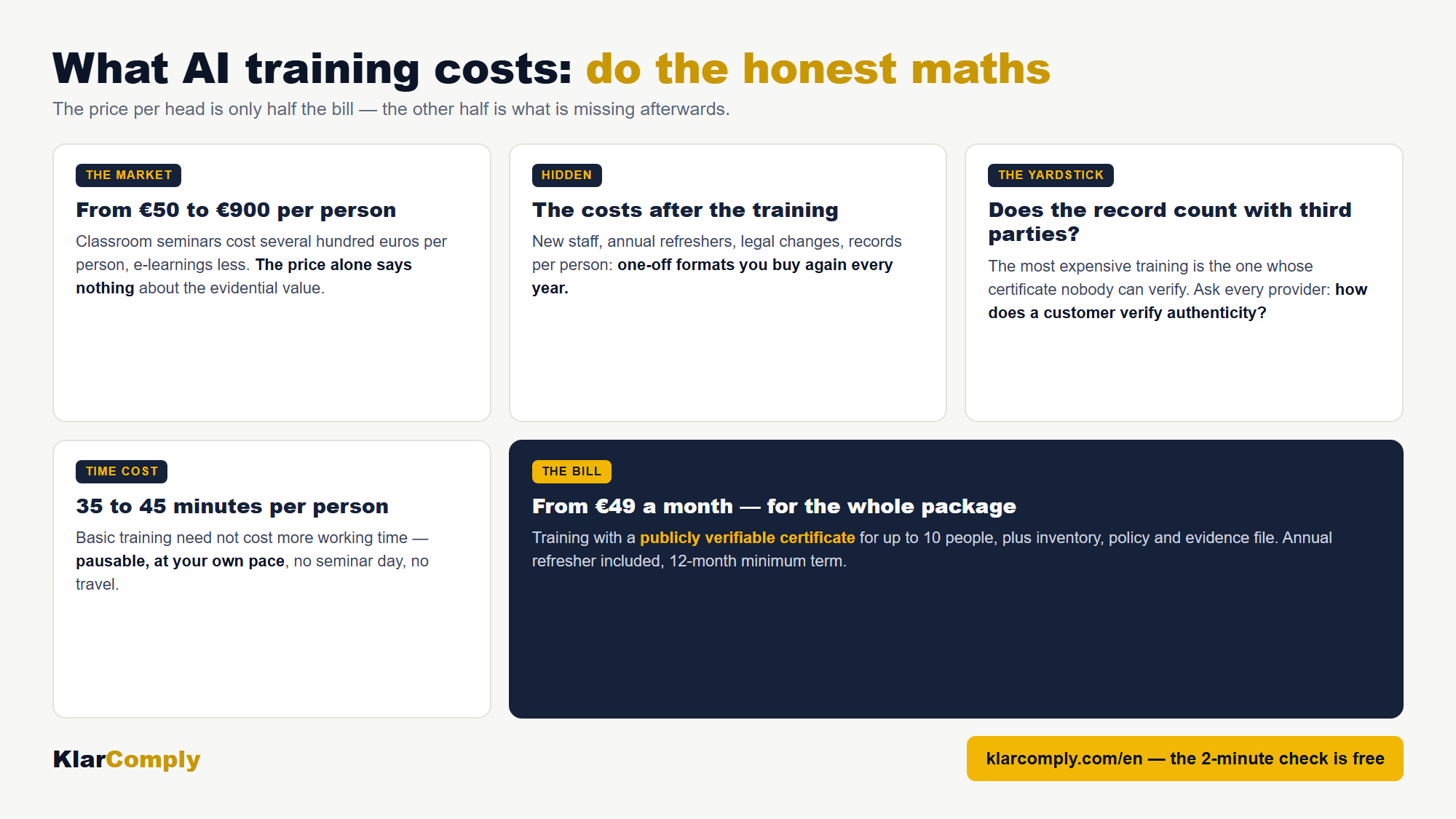
Four models, four pricing logics
Offers are almost never stated in the same unit. One provider quotes €29 per head, another €199 a month. These figures cannot be compared without conversion — and that is exactly where most comparisons fail.
- Click course, one-off per head. A video of 30 to 60 minutes, then a few questions and a certificate of participation. Market rate €15 to €40 per person.
- In-depth online course, one-off per head. More content, often with templates. From about €49 per person.
- Subscription per employee. A monthly amount per person, often around €39. Looks cheap at first and is by far the most expensive model.
- Subscription per company. One amount for the business within a seat band. Our model: €49 up to 10 seats, €99 up to 20, €199 up to 50, €349 up to 100.
The calculation: 10, 25 and 50 people
Calculated for twelve months and for the people who actually use AI — not for the workforce as a whole. For the one-off prices, year one is calculated; Article 4 requires no fixed frequency, but the German federal yardstick recommends an annual refresher, so in practice the amount comes up again.
| Model (12 months) | 10 people | 25 people | 50 people |
|---|---|---|---|
| Click course, €15–40 per head | €150–400 | €375–1,000 | €750–2,000 |
| Online course, from €49 per head | from €490 | from €1,225 | from €2,450 |
| Subscription per employee, €39/month | €4,680 | €11,700 | €23,400 |
| Subscription per company (KlarComply) | €490 | €1,990 | €1,990 |
Where the cheaper provider wins — and that stays so
Against a click course at €15 per head we are not cheaper at any point up to 100 people. Against one at €40 per head we only become cheaper from 50 people.
So whoever has to train fifteen people, needs only the training itself and keeps the records in a spreadsheet of their own anyway does better with a click course for €225 to €600 than with our €990. That is not a calculation error but a decision: we do not sell a video, we sell a system that produces the records and keeps them current. If you do not need that, you do not need us.
The one model every company plan beats
With the subscription per employee the situation is reversed and unambiguous. At €39 per person per month, 25 people cost €11,700 a year — against €1,990 with us. That is a factor of 5.9. For 50 people it is €23,400 against €1,990, a factor of 11.8.
The model looks harmless at first glance because you read the monthly amount per head and not the annual total for the business. With offers like this, always scale up to twelve months and to your real number of users before comparing.
The band effect: just above the limit you pay the most
Every company subscription works with seat bands, and that has an unpleasant property that rarely gets mentioned: whoever is just above a band limit pays the most per head.
| People | Band | Year | per head and year |
|---|---|---|---|
| 10 | up to 10 | €490 | €49.00 |
| 25 | up to 50 | €1,990 | €79.60 |
| 50 | up to 50 | €1,990 | €39.80 |
| 100 | up to 100 | €3,490 | €34.90 |
A business with 25 users pays more per head than one with 10 and more than twice as much as one with 50. That applies to every provider with bands, not only to us. So before signing up, check how far you are from the next band limit — and whether people will join in the next twelve months who fill the band.
What is in the price — and what is not
Because the pure price comparison against click courses does not go our way, the honest question is a different one: what do you hold in your hands in the end when a business customer or an authority asks?
| Service | Click course | Subscription per company |
|---|---|---|
| Training itself | yes | yes |
| Record per person, verifiable | participation PDF | certificate with publicly verifiable ID |
| Overview of who is trained and who is due | no | yes |
| Company documentation (inventory, policy, labelling rule) | no | yes |
| Updates on legal changes | new purchase | included |
| Annual recertification | new purchase | included |
Rows four to six are the difference you pay for. A supplier questionnaire does not ask whether your people watched a video. It asks for the register, the policy, the responsible person and the record per person — with a date. Whoever keeps that themselves saves real money. Whoever does not has nothing to show when it matters.
The other category: role certificates
Whoever wants to train a single person as the responsible officer ends up in a different market with different prices. These offers are not staff training and do not replace it.
| Provider | Format | net per person |
|---|---|---|
| BVDW AI Officer | 2 days | €2,950–3,250 |
| DEKRA AI officer | 3 days live | €2,932 |
| TÜV Rheinland AI officer | 24 teaching units | €2,555 |
| TÜV AI compliance officer | 16 teaching units | €1,960 |
| beauftragter-online, 2-in-1 | distance course | €1,421 |
| KlarComply certificate course | distance course + assessment | €490 |
When the more expensive offer is worth it
In exactly two cases: a tender or a corporate customer requires an accredited personal certificate under ISO/IEC 17024 — that takes a certification body, and we are not one. Or a job profile names a specific qualification. If either applies, we will tell you so and name the providers.
A mistake that gets expensive: confusing seats with headcount
Article 4 covers only the people who actually deal with AI — including freelancers and agencies working on your behalf. A business with 120 employees, 45 of whom use AI, needs 45 seats, not 120.
Whoever calculates the other way round buys a band too large. Before every comparison of offers, check: does the number refer to seats or to employees? With us it is seats — if someone leaves, the seat is freed up, and the person keeps the certificate.
The method, disclosed
- Period: twelve months. One-off prices are calculated as year one.
- Our amounts: annual payment, with two months waived — so ten monthly instalments. 10 people fall into the band up to 10 (€49), 25 and 50 into the band up to 50 (€199). With monthly payment it would be €588 and €2,388 respectively.
- Third-party price ranges: list prices from market observation, as of August 2026, net. The role certificates were taken individually from the providers; the ranges for click courses and per-head subscriptions are bands from several offers, not individual commitments — obtain a specific quote for your case.
- Not included: internal working time. It arises with every model and is roughly the same everywhere.
Frequently asked questions
Do you count the number of employees or the number of AI users?
The AI users. Article 4 of the AI Act covers staff and other persons dealing with the operation and use of AI systems on the company's behalf — so freelancers and agencies too, but not the colleague in the warehouse who never touches an AI tool. A business with 120 employees, 45 of whom use AI, needs 45 seats.
Is a company subscription cheaper than a click course?
Not across the board. Against a click course at €15 per head we are not cheaper at any point up to 100 people; against one at €40 per head only from 50 people. The difference is not the price but what you get: a click course delivers a video and a participation PDF, a company subscription additionally the company documentation, the overview of training status and the annual refresher.
Why is a subscription per employee so much more expensive?
Because the monthly amount grows with every person. At €39 per person per month, 25 people cost €11,700 a year — against €1,990 for a company subscription with 50 seats. That is a factor of 5.9, and for 50 people a factor of 11.8. The model looks cheap because you read the monthly amount per head and not the annual total for the business.
Why does a business with 25 people pay more per head than one with 50?
Because both are in the same seat band. The band up to 50 seats costs €1,990 a year regardless of whether 25 or 50 seats are taken — that is €79.60 per head against €39.80. This effect occurs with every provider that uses bands. Before signing up, check how far you are from the next band limit and whether people will join in the next twelve months.
Does training have to be repeated every year?
The Regulation names no frequency. The paper by the German Advisory Centre for Artificial Intelligence and the Federal Academy of Public Administration recommends an introductory training before first use, regular refreshers roughly annually and training on system changes or legal changes. It is addressed to federal authorities and is not binding for companies, but it is the only published federal yardstick. In practice that means: one-off prices come up again.
Is there a fine for missing training?
No, not a separate one. Article 99 of the AI Act lists the obligations subject to fines exhaustively, and Article 4 is not among them. The 15 million euros in circulation relate to other obligations, among them the transparency obligations of Article 50. The real cost drivers are procurement pressure and organisational fault, not the range of fines.
Where does your company stand?
The free quick check walks through ten points — AI inventory, training status, transparency duties, responsibilities. Two minutes, no sign-up, an honest result and your concrete gaps.
Start the quick check — freeArticle 4 AI Act — AI literacy (full text)
Article 99 AI Act — penalties, exhaustive catalogue
Regulation (EU) 2024/1689 — official full text
Bundesnetzagentur — AI service desk and market surveillance (German)